The Pioneer
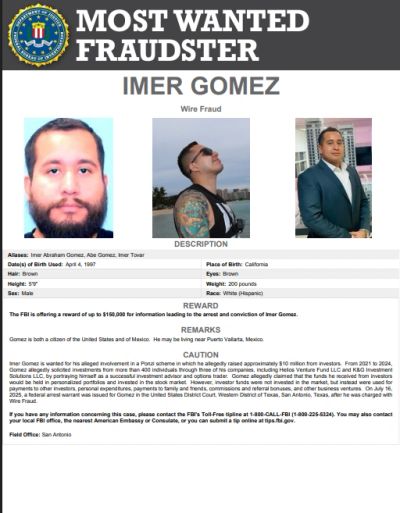
FLASH UPDATE: SAHT Taxpayer Funded Housing Occupant Now FBI's Most Wanted Fraudster
Dear Texans,
Imer Abraham Gomez, that Texas Community Preservation previously reported was living in the San Antonio Housing Trust (SAHT) and Pedcor Investments taxpayer funded Canyon Pass apartments, while under investigation by the Securities and Exchange Commission (SEC) for nearly $10 million in fraud, is now the FBI's Most Wanted Fraudster.
Mind you, the Texas Bond Review Board Executive Director, Robert Latsha, a Texas Governor Greg Abbott appointee, who processes the tax credit applications for "affordable housing" Low-Income Housing Tax Credit (LIHTC) developers, is married to Jean Latsha, the Vice President of Pedcor Investments, who partnered with the SAHT and planned the Canyon Pass apartments.
Clearly, there are no screening mechanisms in place by the SAHT and/or Pedcor Investments on who is living in these taxpayer funded housing projects, that the Texas Department of Housing and Community Affairs, and its Governing Board Chairman Leo Vasquez, another Abbott appointee, should have in place.
Texans deserve better.
Texans deserve the best.
Source:
https://www.fbi.gov/wanted/most-wanted-fraudsters/imer-gomez

Federal Court Records Tie Man Accused in $9 Million Fraud to Taxpayer Funded SAHT Apartments
Dear Texans,
When government entities use tax credits, tax exemptions, public financing tools and other taxpayer-supported incentives to create housing projects, taxpayers have every right to ask a myriad of basic questions:
What accountability comes with the public subsidy?
Who are you placing in and around our community and our children’s schools?
That question becomes particularly relevant at the Canyon Pass Apartments, 25655 Overlook Parkway, where federal court records establish that Imer Abraham Gomez, the central defendant in two civil cases involving an alleged approximately $9 million investment-fraud scheme, had been living.
This also comes on the heels of Texas Community Preservation’s discovery that a convicted Illegal Alien Smuggler was living in the Canyon Pass Apartments and was recently re-arrested for unlawful possession of firearm by a convicted felon.
Nevertheless, this is not an allegation that the San Antonio Housing Trust or Pedcor Investments participated in Gomez’s alleged fraud.
It is a question of taxpayer transparency, tenant screening, public oversight and accountability at housing developments receiving substantial taxpayer funded financial advantages.
And taxpayers should be allowed to ask it.
First, Follow the Public Money
The San Antonio Housing Trust (SAHT) is not simply a private apartment developer.
SAHT says it was created by the City of San Antonio (CoSA) and today operates through several affiliated entities, including a Public Facility Corporation and Finance Corporation. Its governing structure includes City Council members and community members approved by the San Antonio City Council.
SAHT itself explains that its Public Facility Corporation (PFC) can partner with private developers using structures that provide property-tax and sales-tax exemptions, while its Finance Corporation issues private-activity bonds supporting “Affordable Housing” or “Low-Income Housing Tax Credit” (LIHTC) developments.
That brings us back to the Canyon Pass Apartments.
According to SAHT’s own project records, the Housing Trust’s PFC and Finance Corporation partnered with Pedcor Investments to construct Canyon Pass.
The project:
- contains 264 apartments;
- reserves all 264 units for households meeting the 60% Area Median Income limitation;
- cost approximately $52 million to develop;
- uses a 4% Low-Income Housing Tax Credit structure;
- closed financing in December 2020; and
- opened in March 2023.
SAHT identifies Pedcor Properties/Pedcor Investments as the property manager.
In other words, this is precisely the type of public-private housing arrangement where Texas taxpayers deserve transparency and accountability about the standards of screening being applied to its tenants.
Substantial taxpayer dollars were used to finance the construction of the project, taxpayer dollars were used to finance the developer fees for the project, and taxpayer dollars can be used to subsidize rent for the project’s occupants, and can include “complete wraparound assistance” (rent, utilities, groceries, etc.).
These housing projects also don’t pay property taxes to public school districts or emergency services districts for 20, 30, 40, or 50 more years, while the rest of Texas taxpayers do.
Who Was Imer Abraham Gomez?
Two separate federal civil cases accuse Imer Abraham Gomez of operating an investment scheme through K&G Investment Solutions and Helios Venture Fund.
The U.S. Securities and Exchange Commission alleges that from approximately August 2021 through September 2023, Gomez obtained approximately $9 million from clients after representing that he was an experienced securities trader capable of producing double-digit monthly returns.
According to the SEC complaint, clients were led to believe Gomez would establish professionally managed investment accounts, trade securities on their behalf and protect substantial portions of their investments through insurance.
The SEC alleges that was not what happened.
Instead, the SEC alleges that Gomez did not establish the promised individual investment accounts and did not invest the clients’ money as represented.
According to the complaint, investor funds were instead used for such purposes as personal expenses, unrelated businesses, payments to earlier investors and what the SEC described as supporting a “lavish lifestyle.”
These remain civil allegations, not a criminal conviction.
But the SEC was not alone.
Investors Had Already Filed Their Own Case
Investors Ana Munoz, Ignacio Jaimes and Thomas Horst separately sued Gomez, Helios Venture Fund, K&G Investment Solutions and others.
That case became:
Horst, et al. v. Gomez, et al.
Case No. 4:24-cv-03173
U.S. District Court, Southern District of Texas
Thus, Gomez was facing allegations from both private investors and subsequently the federal securities regulator.
But then the SEC encountered another problem:
It could not find Gomez.
Federal Investigators Go Looking for Gomez — and Find the Canyon Pass Connection
During its efforts to serve Gomez with the federal lawsuit, the SEC employed professional Process Servers to check numerous San Antonio addresses.
One of them was:
25655 Overlook Parkway
Apartment 9302
San Antonio, Texas 78260
That is the Canyon Pass apartments taxpayer funded housing project.
On August 8, 2025, a Process Server went to that apartment and encountered Gomez’s brother.
According to the subsequent order signed by U.S. District Judge Xavier Rodriguez, Gomez’s brother told the Process Server that Gomez had moved out of the apartment only a few months earlier and was believed to be living elsewhere in San Antonio’s Stone Oak area.
Think about what that court record establishes.
This was not merely Gomez’s name showing up next to an old address in some commercial database.
A member of Gomez’s own family told the federal Process Server that Gomez had been living there and had only recently moved out. According to federal court documents, Gomez’s mother was also living in a separate apartment in the Canyon Pass apartments taxpayer funded housing project.
The judge ultimately authorized the SEC to leave Gomez’s federal lawsuit documents with an adult at his mother’s Canyon Pass apartment—or post them to the door if necessary.
The SEC had also received information indicating that an occupant of the mother’s apartment was occasionally accompanied by a son around Gomez’s age, causing investigators to return to and surveil the apartment while attempting to locate him.
So the federal record establishes:
Gomez had lived at the Canyon Pass apartments taxpayer funded housing project. His mother resided at Canyon Pass. And his brother was personally encountered at Gomez’s former Canyon Pass apartment during the SEC’s attempt to locate him.
Mexico? San Antonio? Investigators Had Trouble Finding Him
At one point, an unspecified government agency provided information suggesting Gomez had relocated to Mexico.
The SEC then worked through the U.S. Department of Justice’s Office of Foreign Litigation, which retained counsel and an investigator there.
But in May 2026, the investigator concluded that Gomez was not in Mexico and was likely still in the San Antonio area.
The SEC resumed its attempts to find him locally.
Ultimately, after repeated unsuccessful efforts, the federal judge authorized alternative service.
Gomez later failed to respond to the SEC complaint, and an entry of default was entered against him.
An entry of default is not the same thing as a criminal conviction—or even necessarily the final monetary judgment in a civil case—but it means the defendant failed to plead or otherwise defend the lawsuit after service.
Now Comes the Taxpayer-Transparency Questions
This story documents another high-profile case of lack of oversight regarding the SAHT, its leaders, and the City of San Antonio (CoSA), as well as Pedcor Investments who makes tremendous profits off of these taxpayer funded housing projects.
To be clear, Texas Community Preservation doesn’t argue that Gomez’s residence at Canyon Pass establishes that SAHT or Pedcor knew about or participated in his alleged fraudulent investment activity.
They did not suddenly become responsible for an alleged securities scheme simply because a defendant lived in an apartment associated with their project.
But that does not eliminate the legitimate taxpayer-accountability questions.
Quite the opposite.
SAHT tells the public that Canyon Pass is at least a $33.9 million "Affordable Housing" development, although some figures may be closer to $52 million, financed using a 4% tax-credit structure, created through a partnership between government-affiliated SAHT entities and private developer Pedcor.
SAHT also explains that its PFC financing model can provide property-tax and sales-tax exemptions to make “Affordable Housing” projects financially feasible.
When the public is asked (or forced) to support these projects through valuable tax preferences and taxpayer funded financing mechanisms, the public should be entitled to meaningful answers about how those properties are being operated.
For example:
What tenant-screening standards does SAHT require its private development and management partners to maintain?
Does SAHT independently audit whether those standards are actually being followed?
What criminal-background screening policies were in effect at Canyon Pass when Gomez became a tenant?
What policies apply to convictions involving fraud, financial crimes, violence, drugs or other serious offenses?
Are screening standards established by SAHT, by Pedcor, or exclusively by the property manager?
How often are those policies reviewed?
How does SAHT measure public-safety outcomes at properties receiving tax advantages through its partnerships?
Are aggregated crime, eviction, lease-enforcement and screening statistics reported back to the Housing Trust or City Council?
Those are not unreasonable questions.
They are the types of questions that should accompany taxpayer funded housing programs involving millions of dollars in tax advantages as well as the taxpayer funded construction costs, and taxpayer funded tenant assistance.
Taxpayers can reasonably demand transparency concerning the rules, screening procedures, exceptions, audits, enforcement statistics and performance of the publicly supported housing system itself.
“What screening and oversight standards are taxpayers financing, and can the government prove those standards are actually being enforced?”
This is a fundamental public-accountability question.
Clearly, this is not happening and the 90th State of Texas Legislative Session needs to step in and pass a bill that documents how much crime is taking place in these taxpayer funded housing projects and keeps Texas taxpayer communities safe from public safety threat that criminals present, who are being placed in these projects.
Texas taxpayers should not be forced to subsidize the housing of criminals at-large, much less someone convicted of Illegal Alien Smuggling, or someone accused of $9 million dollars in securities fraud.
Canyon Pass Makes These Questions More Important
Canyon Pass is not some isolated private apartment community with no public connection.
It is specifically identified by the SAHT as an SAHT PFC/Finance Corporation partnership with Pedcor Investments, financed through a 4% tax-credit structure.
And SAHT continues expanding similar projects, in particular in the 281 North area as it clearly has its sights set on Comal ISD feeder geography because of the SAHT, Opportunity Home, CoSA, and the special interests behind these projects’ political goals and objectives, and the social beliefs that create these initiatives in the first place.
The SAHT’s current project list includes thousands of additional rental units being developed through various “Affordable Housing” structures, including additional partnerships with Pedcor.
When taxpayer-backed and funded housing expands, transparency and accountability should expand with it.
They should not shrink.
One More Important Timeline Detail
There is one fact Texas Community Preservation will not claim without evidence.
The alleged Gomez investment scheme ran from approximately August 2021 through September 2023.
Canyon Pass opened in March 2023.
That means Canyon Pass was open during approximately the final six months of the alleged fraud period.
However, the federal records reviewed thus far do not establish the exact date Gomez moved into Apartment 9302.
Therefore, it would presently be inaccurate to state conclusively that Gomez was living at Canyon Pass while actively conducting the alleged fraud.
What the federal court records do establish is that Gomez subsequently lived at Canyon Pass and had moved out only a few months before the August 2025 attempt to serve him there.
Texas Community Preservation knows that facts matter.
But, so does transparency and accountability.
The Bottom Line
Two federal civil cases accuse Imer Abraham Gomez of involvement in an alleged investment scheme concerning approximately $9 million in client funds.
The SEC alleges investors were promised professionally managed securities accounts, extraordinary monthly returns and investment protection, while client funds were instead allegedly diverted to personal expenses, unrelated businesses, payments to earlier investors and a “lavish lifestyle.”
Federal court records later document that Gomez had been living at the Canyon Pass Apartments, a SAHT-Pedcor "Affordable Housing" project supported through a 4% LIHTC structure.
His mother was separately documented as residing in another apartment at the same property.
None of that proves SAHT or Pedcor participated in Gomez’s alleged misconduct.
But it absolutely raises a broader public-policy question:
When taxpayers are forced to provide the financial advantages that fund these housing projects, how much transparency and accountability should taxpayers receive in return?
Texas Community Preservation believes the answer should be:
A lot more than they are getting now.
Taxpayers need to know what standards exist, who is responsible for enforcing them, whether those standards are being followed, and what happens when the system fails.
Public money and public tax advantages should come with public accountability.
Texans deserve transparency.
Texans deserve accountability.
Texans deserve better.
Texans deserve the best.
Primary Sources
- Securities and Exchange Commission v. Imer Gomez, et al., Case No. 5:25-cv-00805-XR, U.S. District Court for the Western District of Texas.
- SEC Litigation Release No. 26349, July 14, 2025.
- July 15, 2026 Order Allowing Alternative Service, U.S. District Judge Xavier Rodriguez.
- Horst, et al. v. Gomez, et al., Case No. 4:24-cv-03173, U.S. District Court for the Southern District of Texas.
- San Antonio Housing Trust, Canyon Pass project records.
- San Antonio Housing Trust descriptions of its Public Facility Corporation and Finance Corporation.
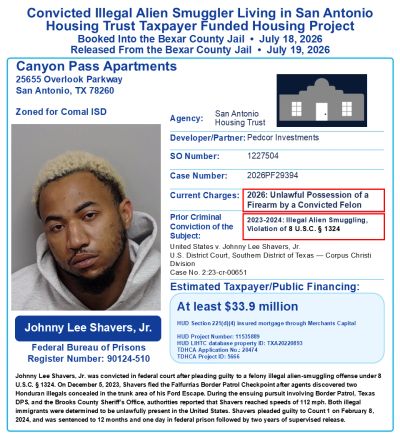
From a 112-MPH Illegal Alien-Smuggling Chase, Federal Prison, to Living in Taxpayer Funded Housing
Dear Texans,
This one is a bit longer than normal.
So, hold your doggies. You wanna read it. Trust me.
In May 2025, multiple persons were arrested in the City of San Antonio - Municipal Government San Antonio Housing Trust's Arbors at West taxpayer funded housing project for human trafficking, drugs, and other criminal charges including at least one individual charged with being a Tren de Aragua member, as U.S. designated Foreign Terrorist Organization (FTO).
So some of you may not be surprised then, by the below information, while some of you will still become enraged enough to chew nails and spit horseshoes. Texas Community Preservation reckons on the latter.
Clearly, Texas Community Preservation is living rent free in the heads of, and getting under the skin of, some folks with CoSA, the SAHT, Opportunity Home, or anyone and everyone who supports all these taxpayer funded "Affordable Housing" projects.
And Texas Community Preservation loves it! 💪 💪 💪
The proof is, that only recently, after years upon years of containing the data, did the Bexar County Jail Activity Reports remove the addresses of the persons being processed into the jail, a matter of public record.
Somebody doesn't want the public to know, when someone is arrested for crime while living in one of the San Antonio Housing Trust or Opportunity Home taxpayer funded housing projects.
You had no problem with it before, until someone shined the light on just how bad the crime is in these taxpayer funded housing projects.
There are still ways to get this information, and Texas Community Preservation still has plenty to crank out in the meantime.
Case in point. See the inset infographic.
----------
That's right! Another heinous convicted criminal living in a San Antonio Housing Trust taxpayer funded housing project called the Canyon Pass apartments was arrested and processed into the Bexar County Jail back in July 2026 for "Unlawful Possession of a Firearm by a Convicted Felon."
A local Lookout Canyon resident that lives near the Canyon Pass apartments was "promised" by the San Antonio Housing Trust that all tenants would go through a background check and no prior felonies, etc.
Yeah....sure!
But, what prior felony did the subject commit and was found guilty of?
Illegal Alien Smuggling!
And the subject wasn't just picking bluebonnets on the side of the road, and decided to just give another feller a lift. There's no way, he didn't know when and where to be.
Which means there had to have been a connection.
Yours truly spent a career in intelligence in the Marine Corps, a tour in the combat zone, and other tactical, operational, and even national-level intelligence agency assignments. Pick a three letter agency, and there's probably one of their business cards in the Texas Community Preservation wallet.
Counter-terrorism, Counter-insurgency, and even International Crime and Narcotics.
Texas Community Preservation knows all too well.....how it works....including on this side of the border.
Enough about me. Here's the run down.
--------------
Summary of the U.S. vs. Johnny Lee Shavers, Jr. Case No. 2:23-cr-00651
Johnny Lee Shavers Jr. was ultimately convicted in federal court after pleading guilty to a felony illegal alien-smuggling offense arising from a December 5, 2023 incident in South Texas. The case began as United States v. Shavers, Magistrate Case No. 2:23-mj-00833, and was later prosecuted as Criminal Case No. 2:23-cr-00651 in the Southern District of Texas. The original complaint charged Shavers under 8 U.S.C. § 1324 with knowingly, or with reckless disregard, transporting an alien who had entered or remained in the United States illegally, in furtherance of that unlawful presence.
The 112-mph Pursuit and Two Concealed Illegal Immigrants
According to the sworn Border Patrol affidavit, at approximately 10:36 p.m. on December 5, 2023, Shavers drove a gray Ford Escape into the Falfurrias U.S. Border Patrol Checkpoint. During the immigration inspection, an agent reportedly saw a blanket covering something in the rear of the vehicle and then saw the back of a person's head. When the agent directed Shavers to put the vehicle in park, the affidavit says Shavers instead drove away from the checkpoint at a high rate of speed.
What followed was a law-enforcement pursuit involving Texas DPS, the Brooks County Sheriff's Office and Border Patrol. The Brooks County Sheriff's Office reported that Shavers' vehicle reached 112 mph during the pursuit. The pursuit ended with his arrest. Agents then discovered two men concealed in the trunk area of the vehicle. The affidavit identified them as Angel Antonio Flores-Oviedo and Denis Abraham Oseguera-Redondo, both Honduran nationals whom agents determined were unlawfully present in the United States and lacked documents permitting them to remain in or pass through the country legally.
The material-witness accounts provided additional details. Flores-Oviedo stated that he had crossed illegally approximately eight days earlier and had been staying at an abandoned house. He said the "driver" arrived, called his name, and instructed him and Oseguera-Redondo to get into the vehicle's trunk. Before reaching the checkpoint, the driver allegedly stopped and told both men to cover themselves with a blanket. Oseguera-Redondo similarly stated that he had entered the United States illegally several days earlier, was picked up from the abandoned house, and was instructed to ride in the trunk underneath the blanket. He told investigators that during the subsequent sudden acceleration he feared for his life. Both witnesses identified Shavers as the driver.
Thus, this was not merely an immigration encounter. The federal complaint specifically alleged that Shavers was transporting unlawfully present aliens in furtherance of their illegal presence, and the affidavit's disposition states that the U.S. Attorney's Office accepted Shavers for prosecution under 8 U.S.C. § 1324 for Alien Smuggling.
Indictment, Guilty Plea and Conviction
A federal grand jury subsequently returned a two-count indictment against Shavers on December 28, 2023. The case summary identifies both counts as “BRINGING IN AND HARBORING ALIENS” under 8 U.S.C. § 1324.
Although Shavers initially entered a not-guilty plea, he later entered into a plea agreement. On February 8, 2024, Shavers pleaded guilty to Count 1. The case specifically records: “Guilty Count(s) 1,” and notes that the plea agreement included a waiver of appeal.
On April 19, 2024, U.S. District Judge David S. Morales formally entered an Order Accepting Guilty Plea, completing the court's acceptance of the plea.
Federal Prison Sentence
On April 30, 2024, Judge Morales sentenced Shavers on Count 1 to:
• 12 months and one day in federal Bureau of Prisons custody
• Two years of supervised release
• Mental-health treatment
• Substance-abuse treatment and testing
• A $100 special assessment
The government moved to dismiss Count 2, and the court granted that dismissal. The sentencing also states that the applicable guideline range, after the court's rulings, was 18–24 months, although the sentence actually imposed was 12 months and one day.
A formal judgment was entered May 3, 2024. The court later ordered Shavers to surrender on June 19, 2024, to the Bastrop Satellite Camp to serve his sentence.
This case ended in a felony conviction, not simply an arrest or unproven accusation: Shavers pleaded guilty to Count 1, the district judge accepted that guilty plea, judgment was entered, and he was sentenced to federal imprisonment. The case characterizes the offense as "Bringing In and Harboring Aliens" and lists its highest offense level as felony.
Current/Post-Prison Status Reflected in the Records
The case did not simply disappear after his prison term. In August 2026, jurisdiction over Shavers' supervised release was transferred from the Southern District of Texas to the Western District of Texas, San Antonio Division.
In short: Shavers was caught transporting two Honduran nationals who were illegally present in the United States and concealed in his vehicle, fled the Falfurrias Border Patrol checkpoint, was pursued at speeds reported by law enforcement as reaching 112 mph, and was eventually prosecuted federally for illegal alien smuggling. He pleaded guilty to a felony § 1324 offense, was convicted, and received 12 months and one day in federal prison followed by two years of supervised release.
….and then was later was put in the Canyon Pass Apartments by the San Antonio Housing Trust and Pedcor Investments, paid for by taxpayers, that happens to be zoned for Comal ISD schools.
He was then was later re-arrested on 18 July 2026 for “Unlawful Possession of a Firearm by a Convicted Felon,” and was then released 24 hours later, back into the public realm.
One last nugget, before we close it out: the Texas Bond Review Board Executive Director, Robert Latsha, a Texas Governor Greg Abbott Appointee, processes the tax credit applications for these “Affordable Housing” Low-Income Housing Tax Credit (LIHTC) applications, including those for Pedcor Investments, of which his wife happens to be Jean Latsha, the Vice President of Development of Pedcor Investments, who planned the Canyon Pass Apartments with the San Antonio Housing Trust and assured local residents of “background checks and no prior felons.”
The San Antonio Housing Trust and Pedcor Investments have also planned a similar LIHTC taxpayer funded housing project called “Creek Bend,” also zoned for Coma lSD and Pieper High School.
The crime will be no different in Creek Bend. Mark the words.
Lastly, Comal ISD property taxpayers have no political representation to CoSA. Yet are supposed to foot the public school bill for these LIHTC projects, that won’t pay property taxes to Comal ISD for 20, 30, 40, or 50 more years.
The crime….and the violent crime in these housing projects….is just CoSA’s way of saying “Thank you!”, to Comal ISD and County property taxpayers.
Texans deserve better.
Texans deserve the best.
Second Arrest in Days at SAHT–Pedcor Tax Credit Apartments
KEY UPDATE:
------------
Texas Community Preservation had obtained the man's name. But, chose to keep it undisclosed.
However, KSAT reported the story this evening, disclosing the man was responsible for the death of a young woman.
Read the story here: https://www.ksat.com/news/local/2026/07/09/everything-is-gone-family-shares-heartbreak-after-a-person-drag-racing-hit-and-killed-a-17-year-old-girl/
------------
Dear Texans,
Not less than 24 hours after a person was arrested at the Canyon Pass Apartments, one of the San Antonio Housing Trust (SAHT) and Pedcor Investments partnership Low-Income Housing Tax Credit (LIHTC) projects in the 281 North area, a separate person was released from Bexar County jail on 7/22/2026, who appears to have been arrested on 6/28/2026 at:
10330 Ingram Rd
Apt (withheld)
San Antonio, TX 78245
This is the address for the SAHT and Pedcor Investments Mesa Apartments LIHTC project.
The person was charged with "Racing on a Highway, Causing Serious Bodily Injury."
(Reference Bexar County SO # 1222472 / Case # 2026PF26814)
Texas taxpayers continue to be forced to pay for this type of behavior, crime, and public safety threat these projects bring into communities.
Texans deserve better.
Texans deserve the best.
Felon-in-Possession of Firearm Arrest at Canyon Pass — a SAHT/Pedcor LIHTC Property
Dear Texans,
An arrest occurred on 7/21/2026 at the Canyon Pass Apartments at:
25655 Overlook Parkway
San Antonio, Texas 78260
for Unlawful Possession of a Firearm by a Convicted Felon.
(Reference Bexar County SO # 1227504 / Case Number # 2026PF29394)
The Canyon Pass apartments are another Low-Income Housing Tax Credit (LIHTC) project that is a partnership between the San Antonio Housing Trust (SAHT) and Pedcor Investments that is zoned for Comal ISD schools, including Pieper High School.
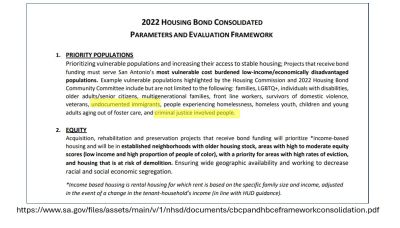
The City of San Antonio (CoSA) maintains an "Affordable Housing" LIHTC policy of prioritizing the placement of "criminal justice system involved" persons in these projects.
Looks like CoSA is sticking to that policy.
Meanwhile, Comal County property taxpayers and Comal ISD property taxpayers at-large, have no political representation to CoSA, who is saddling these hard-working Texas taxpayers in Comal County with CoSA's bill through these LIHTC projects in the 281 North area.
These projects will inevitably bring this type of criminal peril into Comal ISD schools, and also not pay property taxes into Comal ISD, despite bringing in hundreds of students per project into Comal ISD.
All the while, Comal ISD is operating on a $28 million dollar budget deficit this year, while fighting through a $20 million dollar budget deficit last year.
Separately, the Texas Bond Review Board Executive Director Rob Latsha, a Texas Governor Greg Abbott Appointee, oversees the processing of bond reservations for these type of LIHTC projects, including those of his own wife, Jean Latsha, who is the Vice President of Development of Pedcor Investments.
This includes the Canyon Pass apartments where this arrest and threat to public safety just took place.
Texans deserve better.
Texans deserve the best.

Mid July 2026 Update
Dear Texans,
There is good news and bad news regarding the Low-Income Housing Tax Credit (LIHTC) and Housing Finance Corporation (HFC) racket.
The good news: HB 21 is now law, and any "traveling" housing finance corporation (HFC) holding tax exempt property in a county must win approval from that local government by January 1, 2027, or lose the exemption — and half of every tax break must now show up as actual rent reductions or be repaid to local taxing units, including to school districts. Developers are suing to overturn it, so stay tuned.
The bad news: The Trump administration quietly expanded the LIHTC program in last year's "One Big Beautiful Bill Act" (OBBBA) budget bill, where LIHTC developers can now receive up to 12% tax credit vice 9% tax. OBBBA also made a much easier path for bond-financed 4% deals starting this year — so expect more applications targeting geography that is zoned for Comal ISD, Boerne ISD, or even Medina Valley ISD, not fewer.
Meanwhile, Comal ISD just adopted a budget with a ~$28M deficit, Boerne ISD projects growth past 15,000 students, and Medina Valley ISD added roughly 700 students in a single year with a new high school opening this fall.
Every property tax exempt rooftop matters to those numbers, in particular since Comal ISD and Boerne ISD have paid through the teeth to Texas Chapter 49, aka "Robinhood Act" for over two decades.
That's local property tax revenue from Comal ISD and Boerne ISD property taxpayers, being pillaged out of those districts, handed to other school districts, under a social welfare argument, with no accountability of the monies. There's also no guarantee that the monies are even being spent on education.
The School Finance Squeeze Locally:
- Comal ISD adopted a $355 million general fund budget for 2026-27 with a nearly $28 million deficit, after HB 2's interaction with 2023's reduced "hold harmless" funding for recapture districts left Comal ISD nearly empty-handed from the state's $8.5 billion school funding package. (Sources: Herald Zeitung, San Antonio Report)
- Boerne ISD serves over 11,130 students, is projected to exceed 15,000 in five years, and the general assessment is that HB 2's passage had a negative financial impact on it and eight other districts; it was the only San Antonio-area district to pass a VATRE last November, and structured it with golden pennies exempt from recapture. (More about "golden pennies" later.) (Sources: Boerne ISD, TPR)
- Medina Valley ISD expected 10,500–10,600 students for 2025-26, up from 9,800, with a new high school opening in 2026 and a third middle school in 2027, funded by $376M and $290M bonds. (Source: KSAT)
Property taxpayers that pay into Comal ISD, Boerne ISD, Medina Valley ISD, and the Comal County, Kendall County, and Medina County communities at large, all need to push back on City of San Antonio (CoSA) plans and intentions to place LIHTC projects in any geography zoned for these school districts.
Each one of these projects will bring in hundreds of students per project into these ISDs, not pay property taxes for 20, 30, 40, or 50 more years, including not paying property taxes into these ISDs, respectively.
Remember, CoSA's political plans and social goals and objectives with these LIHTC projects will force an undue property tax burden onto taxpayers in these communities, who have no political representation to CoSA.
Otherwise known, as taxation without representation. Where else is this happening across the State of Texas? Why hasn't the Texas Legislature done anything about it?
CoSA's LIHTC policy also verbatim states, it will prioritize placing "undocumented migrants" and "criminal justice system involved persons" in these LIHTC projects. This is what will show up in Comal ISD schools from CoSA LIHTC projects it has planned or already built along the 281 North corridor.
The same would happen to any CoSA LIHTC projects it would build on I-10 West or even Ralph Fair Road, that is zoned for Boerne ISD, but was annexed by CoSA. Medina Valley ISD and Medina County taxpayers should take action now, as well.
It is also rather interesting to note that CoSA is targeting geography for these LIHTC projects with primarily red-voting precincts.
Hard-working Texas taxpayers in Comal County, Kendall County, and Medina County MUST get involved at the local level. The same for any other surrounding counties adjacent to Bexar County and beyond in the Texas Hill Country.
You can start by signing this petition and forwarding it on: "Stop the 281 Steal"
While you are hard at work, so are the LIHTC developer attorney lobbyists, in particular those aligned with CoSA, to undermine the best interests of your communities with these projects. All falsely sold under the pretense of breaking the cycles of poverty and breaking the cycles of criminality.
And far as compassion and special interest goes, our Texas Hill Country communities are compassionate. But our compassion......only goes so far as our trust. And our best interests......are the most special of all.
Even Democrat Bexar County Appraisal District (BCAD) Board of Director Erika Hizel castigated and "tanned the hide" of the San Antonio Housing Trust (SAHT) at a meeting in 2025 about these LIHTC projects. Hizel goes onto to explain to the SAHT and their kleptocratic LIHTC developers, the Public Facility Corporation (PFC) concept has been around in Texas for 40 years. PFCs, like the SAHT, are spending millions and millions more of taxpayer dollars every year. Yet, CoSA remains the third poorest per capita in the country.
"Is the same solution...to the same problem...working after all this time," she remarks.
CoSA (and Bexar County at large) are full of Bolivarian style socialists with their ideas. We're watching it play out in our communities.
The socialists have only ever had one thing to offer: someone else's money.
LIHTC and HFC developers continue to be in a love-lust relationship with taxpayer dollars, which includes some Republican aligned developers with personal and immediate family connections all the way up to Texas Governor Greg Abbott and the Texas Bond Review Board.
Remember: elections have consequences. And not to ride high in the saddle, but our Texas Hill country communities are all championship caliber communities. The success of these communities is a result of the Texas grit in their teeth, the red blood in their veins, and the good decisions these hard-working Texas taxpayers have made for years and the good decisions they continue to make.
And that includes the decisions they make at the ballot box.
More to follow.
Texans deserve better.
Texans deserve the best.

What is a "Community Land Trust?"
1/24/2026
Dear Texans,
You may or may have never heard of the concept of a "Community Land Trust" or "CLT."
Texas Community Preservation will attempt to summarize just exactly what a CLT is in short. And explain why you care, as a hard-working Texas taxpayer.
A CLT is governed by multiple applicable Texas laws. The most applicable law is Texas Local Government Code Chapter 373B: Community Land Trusts.
As most CLTs are Nonprofits, a CLT is also subject to the Texas Business Organizations Code, Title 2, Chapter 22: Nonprofits.
Under applicable Texas Property Codes, a CLT typically:
- Owns the land
- Leases land for long-term, often 99 years to homeowners
- Impose resale restrictions
- Can create Conveyances, such as Deeds and Restrictive Covenants
- Enforce other rules and limitations
A CLT in Texas is also governed by Texas Property Tax Code 11.182 – Community Housing Development Organizations (CHDO).
In Texas, in order to seek tax credits, a CLT must:
- Be a 501(c)(3)
- Provide “affordable housing”
- Meet income and use restrictions
Some CLTs may also fall under Texas Property Tax Code 11.181 (Charitable Organizations) and 11.1825 (Organizations Constructing or Rehabilitating Low-Income Housing: Property Not Previously Exempt)
Under current Texas law, it may also be possible for a CLT to leverage public (taxpayer) funding sources through Texas Local Government Code such as Chapter 380 – Miscellaneous Provisions Relating to Municipal Planning and Development.
There may be other applicable Texas laws that govern CLTs and there are multiple federal laws that also govern CLTs and CHDOs; however, the details are beyond the scope of this article.
Stay here in the saddle a moment with me, though.
Hard-working Texas taxpayers also need to know, that the Texas Constitution, Article I, Bill of Rights, Section 6, states: "No man shall be compelled to attend, erect or support any place of worship, or to maintain any ministry against his consent."
This means the State of Texas [government], and by extension any county or municipal authorities, cannot compel any man (or woman) to support any particular religious organizations. This also means that these government authorities cannot compel you to support any religious organization with your hard-working Texas taxpayer dollars.
--------------
Now, here's the twist in the trail.
Let's say an organization is a 501(c)(3) in the State of Texas, but claims it's only an "arts and culture" organization. Yet, other information demonstrates the same organization is seeking to establish itself as a CLT, the same organization is seeking out Texas taxpayer funding from a municipal source, has been awarded monies from a Texas taxpayer funded municipal source, and the same organization is only going to provide CLT properties for immigrants and asylum seekers of a particular religious faith?
And hard-working Texas taxpayers will foot the bill?
Texas Community Preservation would argue this violates Texas law, as laid out above.
The above scenario is more than a hypothetical, is currently happening, and Texas Community Preservation has proof.
Stay tuned as Texas Community Preservation evaluates its ability to come forward with its discovery on this vary topic.
Texans deserve better.
Texans deserve the best.

Comal ISD Confirms $19 Million Deficit for 2025-26
Dear Texans,
Per the New Braunfels Herald-Zeitung, Comal ISD will suffer a $19 million dollar deficit during the 2025-26 school year.
Although other factors are at play related to this deficit, most hardworking Texas taxpayers with children in Comal ISD schools are not aware that the State of Texas has been siphoning millions of dollars from local property taxes from Comal ISD taxpayers through Texas Chapter 49, aka "The Robinhood Act."
To foot stomp this point, these are LOCAL PROPERTY TAXES being taken out of Comal ISD and handed to other school districts.
These monies go to other school districts, under a social welfare argument. However, the State of Texas and the Texas Education Agency (TEA) have no discernible mechanism in place to track where an ISD's monies go through Chapter 49. Furthermore, there are no discernible measurements of performance and measurements of effectiveness in place to gauge what a poorer ISD is doing with another ISD's local property tax revenue paid by taxpayers from that district's pool.
Over the past 20 years, Comal ISD has been forced to surrender $75 million dollars and counting, under a "your district is too unfairly wealthy" argument, under Chapter 49. This defies logic, in that Comal ISD already has over ten campuses in its geography that are classified as "Title I" campuses.
"Title I" is a designation that means the income level is so low in and around a campus, the students' families are not able to pay into the Comal ISD property tax payer system. The federal government has to step in, and offset the difference.
So then, why is the State of Texas and the TEA continuing to take tax revenue from Comal ISD every other year, giving it to other ISD's with no accountability in place, when the local property tax revenue is clearly needed to stay inside Comal ISD?
It gets worse.
A significant area of Highway 281 North was annexed by the City of San Antonio (CoSA) through political force and manipulation against the personal neighborhoods of Bexar County Precinct 3 Emergency Services District (ESD) 3 Board Members who happened to live in the 281 North corridor (another separate story). This was prior to Senate Bill (SB)-6 passing in the 86th legislature to protect hardworking Texans from forced annexation.
As a result; however, CoSA has planned scale-level "Affordable Housing" low-income projects up 281 North, in particular with its "Transit Oriented District" (TOD) concept, that is intimately linked to CoSA's "Affordable Housing" and socialist vision for "15-minute cities." These CoSA plans are further enabled by HUD's Community Development Block Grant Program.
Each of these plans will bring in hundreds and hundreds of students per project into already overcrowded Comal ISD schools. The "Affordable Housing" developer and the San Antonio Housing Trust (SAHT) will not pay tens of millions of dollars in property tax revenue to Comal ISD per project.
One of these projects is called "Canyon Pass" off of Overlook Parkway, while the other is called "Creek Bend," at 281 North and Borgfeld Drive.
This is a political and legal quagmire. Comal ISD property tax payers have no political representation to CoSA, barring the few residents that live just inside in CoSA city limits along the 281 North corridor.
But, what about the thousands upon thousands of hard-working Texas taxpayers actually located inside Comal County? They didn't elect CoSA City Council Members obviously.
Yet, CoSA can sign up Comal ISD and Comal County taxpayers for the financial and social peril these social experiments bring into Comal ISD schools.
The victory of CoSA District #9 City Council Member Republican Misty Spears is a refreshing sigh of political relief to hardworking Texas taxpayers in Comal ISD communities.
Notwithstanding, Texas Governor Abbott could stop these programs with a pen stroke.
Mind you, CoSA has also annexed Ralph Fair Road next to Fair Oaks Ranch that is zoned for Boerne ISD.
Boerne ISD has already been forced to surrender $118 million dollars through Chapter 49.
Kendall County taxpayers (where Boerne ISD is based out of) have no political representation to CoSA.
And don't forget, that CoSA has annexed geography in Western Bexar County, that is zoned for Medina Valley ISD, that is based out of Medina County.
The same conundrum applies: Medina County taxpayers have no political representation to CoSA.
As long as CoSA maintains these "Affordable Housing" progressive political goals and social goals and objectives, and believes it has the right to impose them on the likes of Comal ISD, Boerne ISD, and Medina Valley ISD....well then....hard-working Texas taxpayer communities in these areas have the right to politically resist them.
And we will.
What's truly needed, is State of Texas Representatives and State of Texas Senators elected by Texans in these areas to pass legislation to forbid CoSA from making such arrangements.
This begs the question: Where else is this happening across the State of Texas?
Further below are key legislative concepts to preserve our Texas Communities related to this particular topic.
The 90th Legislative Session will be here before you know it in 2027. And the 2026 Texas elections will be here even sooner.
The clock is ticking.
And hard-working Texas taxpayers and voters in these districts.....and across the State of Texas....are watching what their elected officials are doing...and what they are not doing.
-------------------------
LEGISLATIVE CONCEPTS NEEDED TO PRESERVE OUR TEXAS COMMUNITIES
Repeal Texas Chapter 49, Excess Local Revenue
Texas Chapter 49, known as “Recapture,” (aka "Robinhood") of the Texas Education Code should be repealed.
As the name states ("Excess Local Revenue"), politicians and their special interest lobbyists believe various communities are too "unfairly" wealthy, and those hard-working Texas communities should suffer school district property taxes being siphoned from their communities and given to poorer school districts. The law also allows the monies to be used in the general fund of the Texas treasury, and not even for educational purposes.
As an example, since the implementation of Texas Chapter 49, Boerne ISD has had approximately $118 million in local property tax revenue taken out of its district, while Comal ISD has been forced to surrender approximately $75 million in the same manner. (Source: Texas Education Agency)
If Texas Chapter 49 cannot be repealed, the following needs to be passed in the next legislative session:
- The public notification radius for Affordable Housing projects shall be extended to 1 mile. This shall include any Affordable Housing projects that are seeking taxpayer funding for construction loans, taxpayer funding for any tenant assistance including rent, and property tax credits of any kind. Currently, the radius is set to 200 feet from the subject property line.
- The public notification radius for any zoning changes to property to allow for multifamily apartment (MFA) related projects shall also be extended to 1 mile. Currently, the radius is set to 200 feet from the subject property line.
- Any voluntary annexation requests by property owners should also incur a 1 mile public notification radius from the subject property line.
- The regular public notification of the aforementioned circumstances shall continue to use traditional vehicles (signage, fliers, websites, etc.) ; however, shall also now include SMS text messaging to the public within that 1 mile radius from the subject property line. The technology exists to do this today (ex: Amber alerts, COVID alerts, etc.) and shall be financed through cities or counties desiring to make the zoning changes that paves the way for Affordable Housing projects in the first place.
- For voluntary annexation requests by a property owner, the SMS text shall include information with links related to annexation of the property within a city or municipality, and all Public Comment related instructions and procedures, windows of time, and other details to maximize public and taxpayer engagement.
- For rezoning of a property to MFA, the SMS text shall include information related to the Affordable Housing project's Public Comment related instructions and procedures, windows of time, and other details to maximize public and taxpayer engagement.
- Voluntary annexation requests, rezoning of property to MFA, and Affordable Housing project 1-mile public notification requirements, including the newly required SMS text requirement, shall be done so, no less than 1 year prior to the Public Comment window, with a follow-on reminder via SMS text no less than six months prior to the Public Comment window.
Geographic Exemption of Affordable Housing Project by ISD's
Affordable Housing projects bring in hundreds or more students into a public school system in one fell swoop. Various Independent School Districts (ISD) are often targeted by Affordable Housing planners because of their political goals, political objectives, and political and social beliefs. The Affordable Housing students' families do not pay school district property taxes into the often already-overcrowded public school system, while the property owner doesn't pay school district property taxes either. These students often need complete "wrap-around assistance" (band instruments, sports equipment, uniforms, technology peripherals, etc.) from either the ISD, Parent Teacher Student Association (PTSA), or the local Housing Authority or Trust. This increases additional burden on taxpayers or local funds, such as through PTSA's. Affordable Housing project developers will often form Limited Partnerships (LP) with a municipality or county's Housing Authority, Housing Trust, or other housing agencies. These organizations can be tax exempt while the Affordable Housing developer seeks tens of millions of dollars in property tax credits through the Texas Department of Housing and Community Affairs (TDHCA). Often, the Affordable Housing developer will "add on" to an existing project 10 years later, and reapply for millions more in property tax credits through TDHCA programs, and bring in even hundreds more students to the ISD.
If Texas Chapter 49 cannot be repealed, the following needs to be passed in the next legislative session:
- Geographic areas covered by an ISD that are remitting funds back to the TEA under Chapter 49 are exempt from any Affordable Housing projects seeking property tax credits for 5 years from the last year the ISD forfeited monies under Texas Chapter 49.
Accountability of Texas Chapter 49 Monies
If Texas Chapter 49 cannot be repealed, the following needs to be passed in the next legislative session:
- There needs to be a dollar-for-dollar tracer mechanism put in place where our local school district property taxes were drawn under Chapter 49, that’s similar to a revolving line of credit and paid back with interest. We deserve to know where our money is going. We should be able to know what other school districts received monies from our local ISD property taxes, how much, when, and what dollar amounts from our monies went into the State of Texas general treasury. If our monies are being redistributed to a school district with falling enrollment and failing grades, we need to have the option to claw that money back from the State of Texas, with interest, and cover what our school districts went without while that money was outside the district .

5-27-2025
Dear Texans,
Unfortunately, since the beginning of 2025, multiple examples of how not just crime, but violent crime, continues to plague the San Antonio Housing Trust’s (SAHT) low-income “Affordable Housing” projects. Similar projects in the City of San Antonio (CoSA) area were subject of comparable criminal and tragic events.
Animal Cruelty: In January 2025, there was a documented grotesque display in the SAHT’s Culebra Creek Apartments near Alamo Ranch, where an occupant was seen heinously beating a puppy on an apartment balcony. Taxpayers and concerned citizens discovered that Animal Control Services (ACS) calls to this “Affordable Housing” project have been off the charts, including calls to pick-up dead animal remains at or near this location. The Culebra Creek Apartments are one of the SAHT and Pedcor Investments partnership projects. Pedcor Investments Vice President (VP) of Development, Jean Latsha, is married to the Executive Director of the Texas Bond Review Board, Rob Latsha, who processes his own wife’s company’s tax credit applications that the Bond Review Board allocates that results in her company receiving millions and millions of dollars in tax credits per projects. This conflict of interest has been made keenly aware to elected officials, including to Texas Governor Greg Abbott and Texas Attorney General Ken Paxton. Paxton’s signature is the last signature on Texas Bond Review Board bonds that guarantee tens of millions of dollars of tax credits to “Affordable Housing” projects, while Texas taxpayers incur more debt as a result.

Murder:Tragically, in mid-February 2025, a teenager was shot and murdered on the property of the SAHT’s “Affordable Housing” project known as Masters Ranch.

Venezuelan Violent Gang Tren de Aragua: In early May 2025, another one of the SAHT’s “Affordable Housing” projects was also the subject of a multi-agency raid by local law enforcement, state, and federal authorities. Multiple arrests were made related to violent and U.S. government designated Foreign Terrorist Organization Tren de Aragua (TDA) gang members at the SAHT’s Arbor at West Avenue “Affordable Housing” project. As documented in this video, the gang members were using the SAHT’s “Affordable Housing” project as a stash house to smuggle illegal aliens and drugs. Despite taxpayers paying millions of dollars for the construction or refurbishing of these types of projects, which includes paying for tenants’ rent, utility bills, and “complete wraparound assistance” in many cases, authorities seized a million dollars in cash from these gang members, while they were “on the way to the beach,” according to the Bexar County Sheriff’s Department.

Attempted Murder / Home Invasion: Lastly, in late May 2025, a teenager was shot three times during a home invasion at the “Woodland Ridge Apartments” in San Antonio. When Texas taxpayers and concerned citizens researched this location’s status, records show that the project and apartment complex is another 100% tax-exempt low-income home housing project, although there does not appear to be a specific connection to the SAHT.

Egregious Finding: In another non-SAHT related, but Section 8 related apartment complex, on 27 May 2025, a small fetus was discovered in a trash canister at the Canlen West Apartments located at 3536 West Avenue in CoSA. As far back as 2019, through Opportunity Home, formerly known as the “San Antonio Housing Authority” (SAHA), Canlen West apartment complex owners received significant taxpayer funded Section 8 subsidies.
Stolen Vehicle: Ironically, right next to where the SAHT and Pedcor Investments is placing the Creek Bend low-income “Affordable Housing” project on Borgfeld Drive, according to a social media post and related to Bexar County Sheriff case # 2025-BCSO-007462, a resident of Willis Ranch right next to the Creek Bend location, had his vehicle stolen from his driveway. The vehicle was even more ironically recovered at the SAHT and Pedcor Investment’s low-income “Affordable Housing” apartment complex called “Canyon Pass” just down the road off of Overlook Parkway.
Elected Official Speaks Out: Bexar County Appraisal District (BCAD) elected Director Erika Hizel’s public comments at the 2/21/2025 SAHT open meeting, demonstrate how these projects deplete public school financing to the tune of tens of millions of dollars per project, and represent over $200 millions of dollars in public school financing across Bexar County. Ms. Hizel goes onto describe that the "Public Facility Corporation" (PFC) concept, like the SAHT, hasn't changed in 40 plus years. Yet, CoSA still remains the 3rd poor city in the U.S. per capita. So, why keep doing it?
CoSA and its District 9 (D9) continue with plans to lay siege to the 281 North corridor with these low-income “Affordable Housing” projects, that includes geographic areas served by Comal ISD, while Comal County taxpayers have no political representation to the CoSA. To boot, Texas taxpayers recently uncovered that CoSA D9 City Council candidate Angi Aramburu is directly connected to aforementioned Pedcor Investments VP of Development Jean Latsha.
Boerne ISD Be Warned: With CoSA having annexed huge portions of Ralph Fair Road next to Fair Oaks Ranch that is zoned for Boerne ISD, Boerne ISD and Kendall County taxpayer communities should also beware of the criminal peril and financial peril these projects will bring into those communities and school districts, regardless of how politically incorrect it is. The aforementioned reports substantiate such information.
Both Comal ISD and Boerne ISD have been subject of Texas Chapter 49, aka “Robinhood Act” that has taken almost $200 million dollars combined between both school districts property tax revenue streams, where the State of Texas distributes your local property tax revenue to other school districts. This is under a social welfare argument, the hard-working Texas taxpayers in Boerne ISD and Comal ISD are too unfairly wealthy. Yet, the same hard-working Texas taxpayer communities in Boerne ISD and Comal ISD are to sit idly by while HUD, the SAHT, and other special interests aim to upend these communities with similar projects as described above, bring hundreds and hundreds of students per project into these already overcrowded public school districts, and the developer and essentially property owner pay no property taxes into these public school systems. Not to mention, the rent, utilities, and other “complete wraparound assistance” in these projects are also paid for by Texas taxpayers.
Medina Valley ISD Be Warned: Additionally, there are swaths of geography in Western Bexar County where CoSA has annexed land that is zoned for Medina Valley ISD. The dynamics and warning are the same, with Medina County taxpayers having no political representation to CoSA.
Remember, Texas taxpayers are paying for these low-income “Affordable Housing” projects two and three times over or more: taxpayers are paying for the construction costs, taxpayers are paying for the “Affordable Housing” developer fees, taxpayers are paying for the rent, utilities, and complete wraparound assistance in some of these projects, taxpayers are paying for the burden on emergency services serving these projects, and taxpayers are paying for the public school costs associated with these projects by the amount of students they bring into public school systems where the projects are already being placed. And don't forget about Texas Chapter 49 ya'll!
To find out more about what you can do to preserve your community, visit https://www.texascommunitypreservation.org to learn how “voting is not enough,” and that as hard-working Texas taxpayer communities, you must get involved.

3-17-2025
Dear Texans,
The new 2025 HUD SDDA map is out. See attached graphic to the left.
Hard-working Texas taxpayers in these areas should understand these geographic designations by HUD mean that HUD will financially incentivize Section 8 and low-income "Affordable Housing" developers to target and purchase land in these areas.
Low-income housing developers, such as Jean Latsha with Pedcor Investments, will use attorney lobbyists, to convince land owners to apply to have their properties rezoned for Multi-Family Apartments (MFA) in these areas, before they make an offer to purchase the properties. Jean Latsha's husband, Rob Latsha, is the Executive Director of the Texas Bond Review Board, of which reserves the bond to guarantee the millions of dollars in tax credit her company will receive per project, a conflict of interest hard-working Texas taxpayers have filed complaints with to the Texas Ethics Commission.
Low-income housing developers might also even use attorney lobbyists, such as Rob Killen of Killen, Griffon, and Farrimond, to voluntarily apply to have their properties annexed into a municipality. Once annexed, the property will then be rezoned to MFA, to make way for Section 8 or low-income "Affordable Housing" through the same attorney lobbyist. This has already happened at least once in Boerne, with Boerne citizens only finding out after the project was nearly complete.
The red portions on the HUD SDDA map are considered "metro" areas, while hard-working Texas taxpayers that live in these areas, know these areas are anything but "metro" and represent the pristine and beautiful Texas Hill Country. The "blue" portioned areas are HUD designated "Zip Code Tabulation Areas "ZCTA" which HUD also uses to plan Section 8 and low-income "Affordable Housing."
The "purple" designated areas are considered "non-metro" areas, and also incentivize Section 8 and low-income "Affordable Housing" to target these areas.
Bulverde-Spring Branch and huge swaths of Western Comal County, all zoned for Smithson Valley High School, will remain targeted by HUD for Section 8 and low-income "Affordable Housing."
The Fair Oaks Ranch area that will remain targeted by HUD for Section 8 and low-income "Affordable Housing," is zoned for Boerne ISD.
Medina Valley ISD may also be impacted in far Western Bexar County, where this school district provides public schools in Western Bexar County.
Any Section 8 or MFA "Affordable Housing" projects built in these areas will bring hundreds and hundreds of students into already overcrowded school systems, and receive millions and millions of dollars in property tax credits per project, while the rest of hard-working Texas taxpayers in these communities are expected to make up the difference.
These hard-working Texas taxpayer Hill Country communities are also all in an existential water crisis, where some residents in single family communities are experiencing their wells drying up. Yet, the State of Texas and HUD aim to target these areas with high-density taxpayer subsidized Section 8 or "Affordable Housing” that will consume more water.
The larger Boerne area and the previously identified swaths of Kendall County were removed from the same HUD designation in the 2024 map, comparatively.
Nevertheless, these plans are all a reflection upon political and social goals and objectives to play "social roulette" with hard-working Texas taxpayer communities and disregard for the negative impact high density taxpayer subsidized housing will have in these areas.
Per Bexar County Appraisal District (BCAD) Board of Director Erika Hizel and her public comments made at the 2/21/2025 San Antonio Housing Trust (SATH) public meeting, over $2.2 billion dollars have been pulled out of the property tax revenue system in Bexar County alone by these projects, representing over a couple hundred million dollars that would normally go to public school district financing, while many of these already existing low-income housing projects have low occupancy rates.
So, why build more and in particular place them in Texas Hill Country communities?
A political conundrum remains, in that while the City of San Antonio, or even Bexar County, makes these Section 8 or low-income "Affordable Housing" plans inside areas serviced by Boerne ISD, Comal ISD, or even Medina Valley ISD, taxpayers in Kendall County, Comal County, or Medina County have no political representation to the City of San Antonio or even Bexar County.
The 89th State of Texas Legislature is also in full swing, where it appears that developer lobbyists are convincing even Republican State Representatives and State Senators, to propose and support legislation that is not in the best interest of hard-working Texas taxpayers in single-family residential communities, and even rural semi-suburb communities across the Lone Star State.
Texas Community Preservation has also established contact with the Texas Neighborhood Coalition (https://www.txneighborhoodcoalition.com) and aims to explore partnership and synergistic opportunities with their efforts.
Visit https://www.texascommunitypreservation.org to find out more about how you can preserve our Texas communities.